
A Response Is Not a Customer
The next direct-marketing advantage is separating people who signal interest from people an offer can actually convert—and proving what the campaign added.
With Steve Godwin
President, Analytic Marketing Partners

- Why a visible response can still hide conversion risk
- How the 40% postal incentive can fund a real test
- Why consent and identity now belong in the offer
- How value behavior and browser policy reshape audiences
- What printers, agencies, lenders and data leaders should change
- Three moves to measure customers, not busy signals
30-Second Executive Read
What changed: Current evidence is separating visible response from conversion readiness across credit, retail, insurance, identity and measurement.
Why it matters: The audience producing the most signals may not be eligible, persuaded or incremental—and a high reported return can still misallocate budget.
What to do next: Qualify before ranking, design friction into the offer, and test the completed economic outcome against a real holdout.
The response rate is doing too many jobs
Direct marketers have learned to collect more signals than ever: a click, a scan, a quote request, a prequalification start, a retail cart, a broker-assisted enrollment. The uncomfortable part is that a signal can describe interest without proving that the audience can convert, that the offer changed the decision, or that the revenue was incremental.
The Federal Reserve’s November 2 release makes the distinction unusually visible. Banks reported stronger credit-card demand in the third quarter, while also tightening credit limits and the extent to which they lend below credit-score thresholds. Over the prior year, respondents were more likely to approve super-prime and prime applications and less likely to approve subprime applications. In the detailed table, 14.3% of 49 responding banks reported moderately stronger card demand over the latest quarter. The special question is directional rather than a consumer-level approval model, but the commercial tension is real: need is rising while convertibility is sorting more sharply.
That changes acquisition. A lender that optimizes response alone can buy expensive applications its underwriting cannot accept. An agency can celebrate form fills while the client sees no funded accounts. A printer can execute perfectly and still be blamed for a list-and-offer mismatch. The right unit of value is not the first response; it is the qualified, completed, economically useful outcome.
Offer behavior can reveal value without proving low value
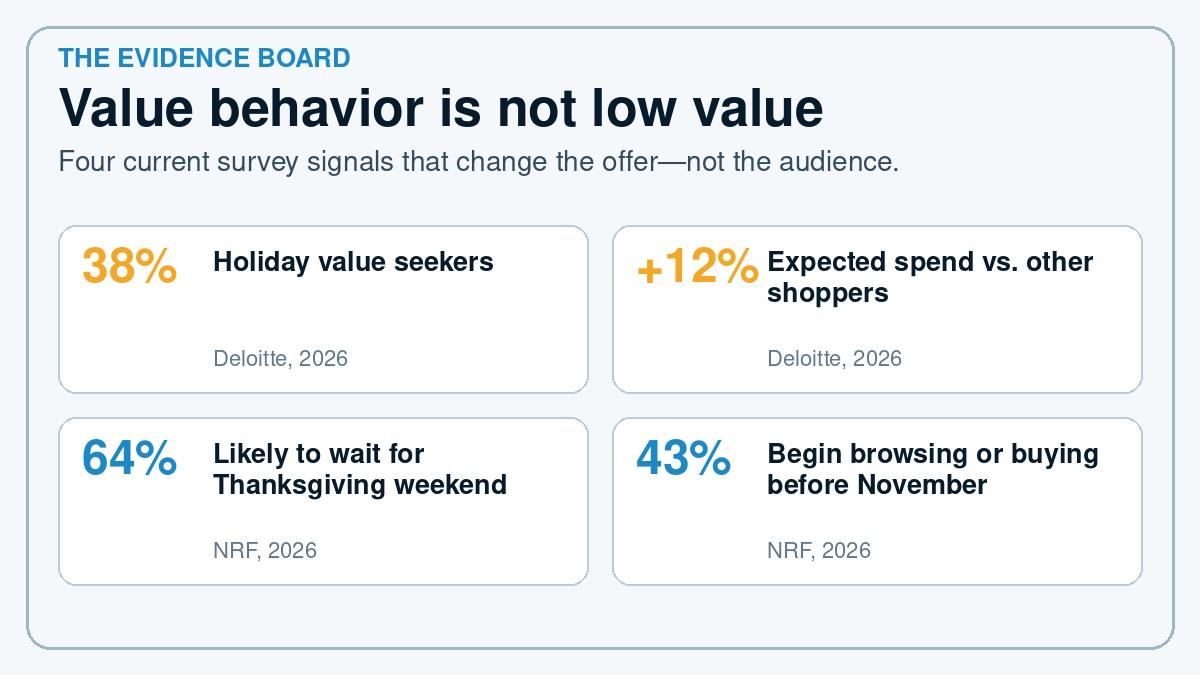
Retail evidence points the same way from the other direction. Deloitte’s 2026 holiday survey found that 38% of 4,000 U.S. consumers qualified as “value seekers” by using five or more saving behaviors—yet they expected to spend 12% more than other shoppers. NRF found 64% of 8,094 adults were likely to wait until Thanksgiving weekend to do most holiday shopping, even though 43% planned to start browsing or buying before November. Planned behavior is not observed revenue, and the two studies use different samples. Still, both undermine a common segmentation error: deal-seeking is a shopping strategy, not a household-value verdict.
The practical decision is to stop suppressing an audience merely because it responds to promotions. Instead, qualify on product fit and durable capacity, then vary offer architecture: price protection, bundles, rewards, financing, free shipping or a smaller first commitment. Read contribution margin, repeat purchase and returns alongside conversion. The audience can be responsive and valuable; the offer must prove it.
Attribution describes a path; incrementality defends the budget
IAB’s Cross-Channel Measurement Decision Guide, whose public-comment period ended November 4, was built for cases in which attribution, marketing-mix models and incrementality tests disagree. Its own example is pointed: a channel can report strong attributed ROAS that an incrementality test does not support. The guide is not a finished standard and IAB has an industry interest, but its decision-first framing is useful.
Mail makes the issue tangible. QR codes, personalized URLs and matchback can connect exposure to response; none creates a counterfactual. A current Valpak case study is more informative because it reports a matched control: a sporting-goods campaign claims 35.26× incremental ROAS, $4.16 million in incremental sales and 24.57% higher sales per household among recipients, based on a 926,788-household receipt panel and a separate 1.15-million-consumer visit panel. It is vendor-promoted evidence and needs independent replication, but the study design is stronger than a path-only claim.
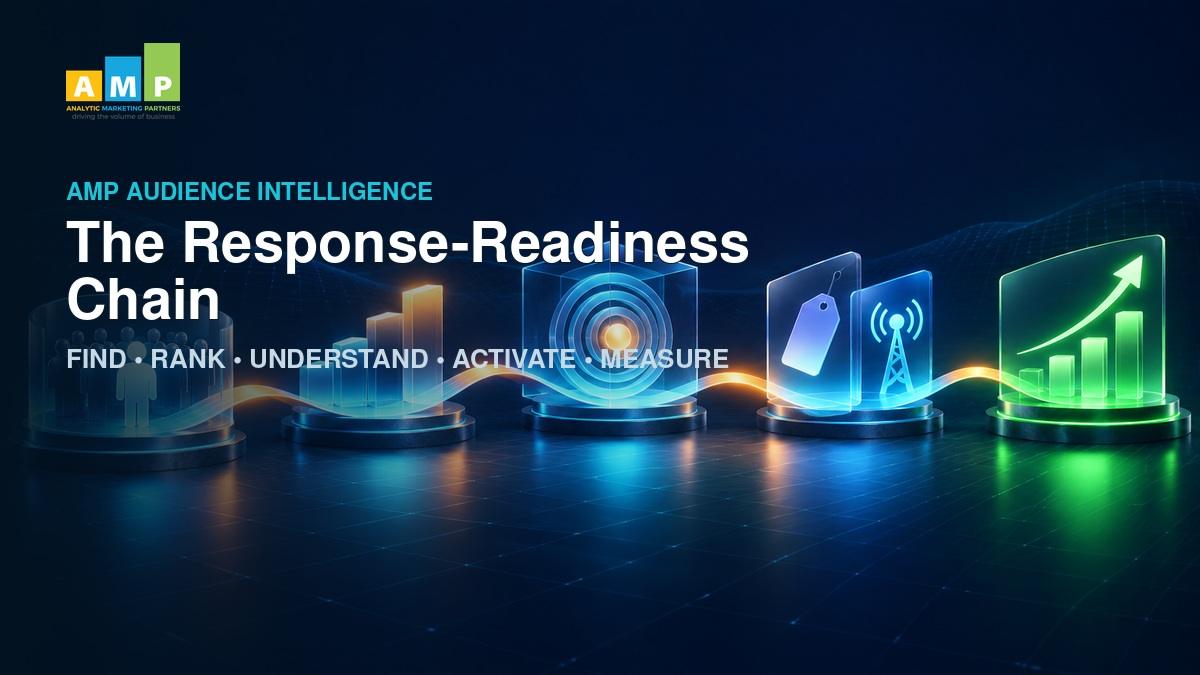
The decision is simple: use attribution to diagnose journeys and a holdout to decide whether to scale. AMP’s audience sequence makes the roles explicit—find the relevant audience, rank the opportunity, understand motivation, activate the right offer and channels, then write response and revenue back against the control.

A 40% postage break should buy learning, not just volume
Evidence: USPS says the 2027 Direct Mail Discovery promotion will give eligible companies that have not mailed in two years a 40% discount on 5,000 pieces per mailing, up to 100,000 pieces during the April 1–September 30 period. PostalPro still labels the detailed guidebook “coming soon,” so eligibility mechanics remain an execution risk.
Decision and implementation: Printers and agencies should sell this as a controlled acquisition entry test, not a generic postage sale. Define one qualified audience, two materially different offers, shared mail-and-digital identity logic and a no-additional-mail holdout before estimating volume. Test: read delivered cost, qualified response, conversion, contribution and 60-day ROMI—not scans alone. AMP lens: durable audience qualification, local market context and response writeback can turn the incentive into a reusable learning asset.

Consent and identity are now conversion design
Evidence: During Marketplace open enrollment, CMS requires electronic consumer authorization before an agent or broker takes action and has tightened agent identity proofing and applicant-document verification. CMS says prior anti-fraud investigations led to hundreds of thousands of canceled enrollments; the controls protect consumers but add completion steps.
Decision and implementation: Insurance marketers should move proofing expectations into the creative and handoff: tell prospects what will be required, why it protects them and how quickly the authorized step expires. Sequence mail, email or SMS only where consent permits. Test: compare authorization starts, verified completions, assisted-enrollment cycle time and complaints over the full open-enrollment window. AMP lens: qualify eligible households first, then let current intent sharpen timing; never treat missing digital activity as disinterest.

Three signals worth acting on now
Safari just raised the price of rented identity
Evidence: WebKit says Safari 27 blocks network access to certain third-party identity-resolution infrastructure. Decision: separate consented first-party identity from covert cross-site matching. Implementation: strengthen address quality, direct identifiers, preference capture and channel-specific measurement. Test: monitor match rates, reachable audience, opt-in conversion and cost per completed outcome by browser and channel. The boundary: WebKit’s post states the policy; it does not quantify marketer-wide revenue loss.
Value shoppers need a better offer, not a lower rank
Evidence: Deloitte’s value-seeker segment planned higher spend; NRF shows deal timing is widespread. Decision: keep qualified value seekers in the audience and change the offer. Implementation: test bundles, guarantees, loyalty value and financing against blanket discounting. Test: contribution, return rate and 90-day repeat purchase by offer cell.
Direct mail’s strongest claim is the outcome it added
Evidence: IAB’s draft guide warns that attributed ROAS and incrementality can conflict; a vendor case reports a large test-control result. Decision: reserve part of every scalable campaign for causal learning. Implementation: randomize at the household or account level before production. Test: incremental conversion and contribution with uncertainty—not a matchback total by itself.
The same evidence changes four jobs differently
Conversation Radar: five leadership questions moving across markets
Credit demand versus approval: banks and lenders should ask whether acquisition spend is concentrated where applications can actually fund.
Consent as conversion: insurance and other regulated marketers should ask whether protective steps are explained early enough to preserve trust.
Value without low value: retailers and travel marketers should ask whether promotion behavior is being mistaken for weak customer economics.
Identity after Safari: data and technology leaders should ask which campaigns still depend on non-consented cross-site resolution.
Attribution versus lift: agencies, printers and brands should ask which budget decisions have a counterfactual, not merely a response path.

Three Moves to Buy Real Customers, Not Busy Signals
- Qualify before you rank. Start with serviceability, eligibility, geography, financial capacity and explicit exclusions; use intent to sharpen timing, not to create relevance. Measure the share of responses that become qualified completions.
- Make friction part of the offer. Treat consent, proofing, underwriting, scheduling or inventory as customer-experience inputs. Explain the next step before asking for the first response. Measure abandonment and time-to-complete by cell.
- Buy one counterfactual. Keep a randomized no-additional-contact group large enough for the decision. Attribute journeys for diagnosis, but scale on incremental conversion, revenue, contribution and ROMI.
What AMP Would Test
Audience: households that meet durable product-fit and eligibility rules, stratified by current intent and local market capacity. Offer: standard response-led creative versus readiness-led creative that explains value and the next completion step. Channels: coordinated mail and digital using the same audience logic. Holdout: randomized 10% no-additional-contact control within each stratum. Timing: two waves, with 14-day response and 60-day completed-outcome windows. Success: qualified completion, cost per incremental completion, contribution and ROMI; secondary reads include abandonment, complaints and channel assist. Ten percent is a planning assumption, not a universal sample-size prescription.

The first response is evidence—not the finish line
I believe direct marketers lose credibility when we ask one metric to prove everything. A response can tell us an audience noticed, but it cannot by itself tell us the prospect was eligible, the offer overcame the real barrier or the campaign created incremental value.
Consider this... qualify the opportunity before you rank it, then keep one honest holdout so the budget learns something.
Ask yourself... which step between interest and economic value is your current report hiding?
— Steve
Analytic Marketing Partners
Turn response into a measurable customer decision
If your campaign produces signals but the economics remain unclear, AMP can help translate the evidence into a qualified audience, practical offer test and defensible measurement plan.
Talk with AMP: 864.498.5997 · sgodwin@ampanalytic.com · www.ampanalytic.com
Sources, methods and limits
- Federal Reserve, October 2026 SLOOS, released Nov. 2. Bank survey; directional lending-policy evidence, not an individual approval model.
- Federal Reserve, SLOOS Table 1. Detailed respondent counts and percentages.
- Deloitte 2026 Holiday Retail Survey, Oct. 15; 4,000 U.S. consumers, online panel, ±2 points. Planned behavior; commercial research.
- NRF Holiday Survey, Oct. 20; Prosper Insights & Analytics, 8,094 adults, ±1.1 points. Planned behavior; association-sponsored.
- IAB Cross-Channel Measurement Decision Guide announcement, Oct. 20. Draft for public comment through Nov. 4; industry-interest disclosure.
- USPS 2027 Promotions; Direct Mail Discovery terms. Detailed guidebook pending as of publication preparation.
- CMS Marketplace Anti-Fraud Actions, current for open enrollment. Primary government source.
- WebKit: Blocking Identity Resolution Infrastructure, Oct. 19. Platform-owner policy explanation; no market-wide revenue estimate.
- Valpak sporting-goods incrementality case. Vendor-promoted case; matched-control design and large panels, but not independent generalization.